
#FacesOfMyeloma: Kayleigh’s story of living well with myeloma, as a carer
Latest news
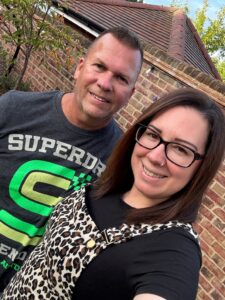
When Kayleigh’s husband was diagnosed with myeloma in October 2020, everything changed overnight.
The couple are from Basingstoke, UK, about an hour from London. They both worked together in a shopping centre, meaning they are on their feet all day interacting with the general public. Martin’s symptoms began as a bad back—something Kayleigh initially dismissed—and spiraled into a life-changing diagnosis.
“He had a bad back for about four to six weeks. I thought, you know, you’ve probably just seized up. You’ve not been moving—carry on.”
But it escalated quickly. During COVID-19 lockdown, what seemed like a simple long-term back problem revealed itself as a collapsed vertebrae and four other spinal fractures. He was almost paralysed.
Their diagnosis experience
“We’d gone out for his birthday and his legs kept giving way, which he later admitted had been happening for a while. He couldn’t feel anything from his waist down.”
An emergency MRI and several consultations revealed the myeloma diagnosis. Kayleigh already had some knowledge of myeloma—as unfortunately her aunty had passed away from it a couple of years earlier. Because of this unfortunate experience, she immediately feared the worst. “I went into a bit of a meltdown after.”
In those early days, her aunt’s short experience with myeloma weighed heavily. “My mind went straight to that place—this is not a good place to be. I would never have connected a bad back to blood cancer.”
But this became her most important lesson: “Part of me wishes I didn’t know about myeloma from my aunty’s experience, but it did make me very much understand that every patient is different and everyone responds to treatment differently. It takes a while to accept that, but it’s crucial.”
Overnight transformation
After three weeks apart, Martin in hospital and her at home, discharge defined her new reality.
“I drove to hospital as his partner and left as much more—doctor, nurse, carer, cook, partner and much more. They wheeled him out, we wedged him in the car with his back brace. The nurse gave me carrier bags of medication.” The medication covered their kitchen counter. “I was so worried I would give him the wrong thing.”
Learning and living
They kept the diagnosis private initially. She spent early weeks reading everything on the Myeloma UK and Blood Cancer UK websites. “I wanted all the information I could get hold of to make the best decisions for us as a couple. I didn’t want to leave all the decisions in the hands of someone else.”
Treatment went well, mentally we broke it down week by week. “If you think it’s six months, to me, that feels overwhelming. But if you just focus on the next two weeks you are living more in the moment and appreciate the little wins much more.”
COVID meant she couldn’t visit during long hospital stays. “This may sound selfish, but that was good for me. It would have affected me more had I seen him as poorly as he was. So I would say it’s good to spend time away from hospitals and think of your own wellbeing, at times”
He achieved remission and returned to work in April 2022. “That first day back to normal, I felt like I’d let my child go to school. Prior to that, I had control over everything. Now he was in a shopping centre with thousands of people daily. I’d lost control, which was hard initially.”
The carer’s reality
After 12 months, she sought counselling. “I was really struggling with anxiety, mainly around infection risks. The trauma runs deep.”
Now she runs a support group for carers. “When people come in, they say, ‘I thought I was the only person that felt like this.’ But we are all have much in common.”
One reflection that probably affects all carers: “People would always ask how Martin was. But I’d think to myself, no one ever asks how I am? We’re going through this as a couple, in completely different ways.”
She quotes Jamie Theakston, a famous radio presenter in the UK, who said: “’I wasn’t diagnosed with cancer. My family was diagnosed.’ That is so right. You do get diagnosed as a family. You are all affected.”
Words of wisdom
Five and a half years in, her main reflection: “Everyone is so different. Don’t focus on the negatives or the issues that other people went through. Just because something happened to one person doesn’t mean it will happen to you. I wish I’d believed that as much at the beginning and just realised that this is your own individual journey.”
And crucially her key advice for a carer is to take time to look after your own well-being: “If I’m not in a good place, I’m no good to Martin. You have to take time out for yourself.”
Check out our Faces of myeloma series to read more stories from patients and carers around Europe.